
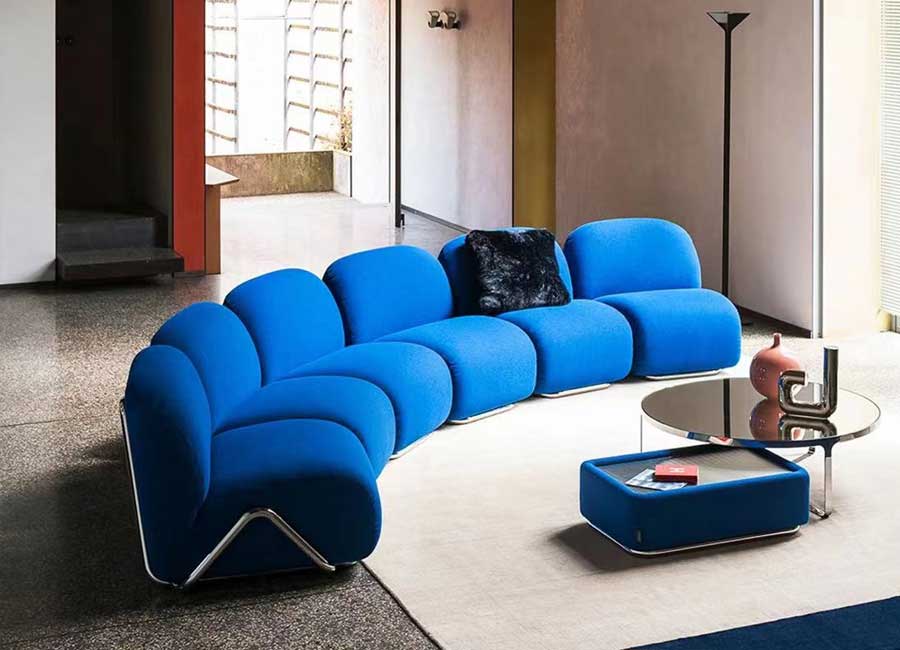
Length and depth can usually be changed within an existing model; a new radius or a new silhouette cannot — it becomes a new development. The boundary is not willingness, it is patterns: a different curve needs different frame segments, paper patterns and fabric panels. Knowing which level you are asking for decides the lead time and the MOQ.
Three levels of customisation
| Level | What changes | Lead time | MOQ |
|---|---|---|---|
| 1. Material | Fabric, leather, colour, foam firmness, throw pillows | 20 days | 5 pieces per model |
| 2. Dimension | Length, depth, seat height, module count within the model | 20 days | 5 pieces per model |
| 3. New shape | New radius, new silhouette, new frame and patterns | 30 days from approved drawing | Quoted with the drawing |
What cannot be changed, and why
A fixed chaise cannot become modular. The chaise unit has its own frame and cushion geometry; making it detachable changes the structure, not the upholstery.
A very tight radius has a structural limit. Below a certain radius the frame segments become too short to joint properly, and the fabric cannot be pulled without pleating. We will say where the limit is rather than accept an order that cannot be built well.
Seat depth has a comfort limit. Adding 10 cm to a deep seat changes the back angle and the cushion support. It can be done, but it should be tested on a sample, not assumed from a drawing.
The drawing approval process
A three-view drawing with dimensions, frame specification and material notes is issued within one working day. You mark it up, we revise, and production starts only after the approved version and the deposit are received. The approved drawing becomes part of the order record, which is what makes a later conversation about “what was agreed” short.
If the piece has to enter an existing room, send the access route as well: door width, lift size, stair turns and any low ceiling. A sofa that fits the floor plan but not the lift is a common and expensive mistake.
Common mistakes
- Changing the radius after fabric is cut. New panels, new consumption, new schedule. Confirm the curve before the fabric order.
- Changing the fabric after the frame is built. The cover is cut to the frame; a late change is a new cutting sequence.
- Using a straight-sofa pattern on a curve. Tight on one side, loose on the other; steaming will not fix it.
- Ordering a second dye lot for a phased project. The difference shows when pieces sit side by side.
Questions buyers ask
Can I make a 3 m sofa from a 2.6 m model?
Usually yes at level 2: the length changes within the same frame family, and the price is quoted per configuration. The seat depth and back angle stay the same unless you ask to change them.
Can I add 10 cm to the seat depth?
It can be done on most models, but it changes the back angle and the cushion support. We recommend confirming it on a sample rather than on a drawing alone.
Is a new radius expensive?
It is a development cost, not a per-piece surcharge: new frame segments, new paper patterns and new panels. It is quoted separately, and the per-piece price after development is usually close to the original model.
How many revisions does the drawing include?
As many as needed before approval; the drawing is not the constraint. The constraint is time — every revision moves the production start date.
Send the model, the dimensions you want and the access route, and we will confirm which level applies and what it does to the lead time. The process is described on the craft page; current models are in the curved sofa collection; short answers are in the FAQ.
Updated November 2026. FEILIGE FURNITURE, Foshan.

