
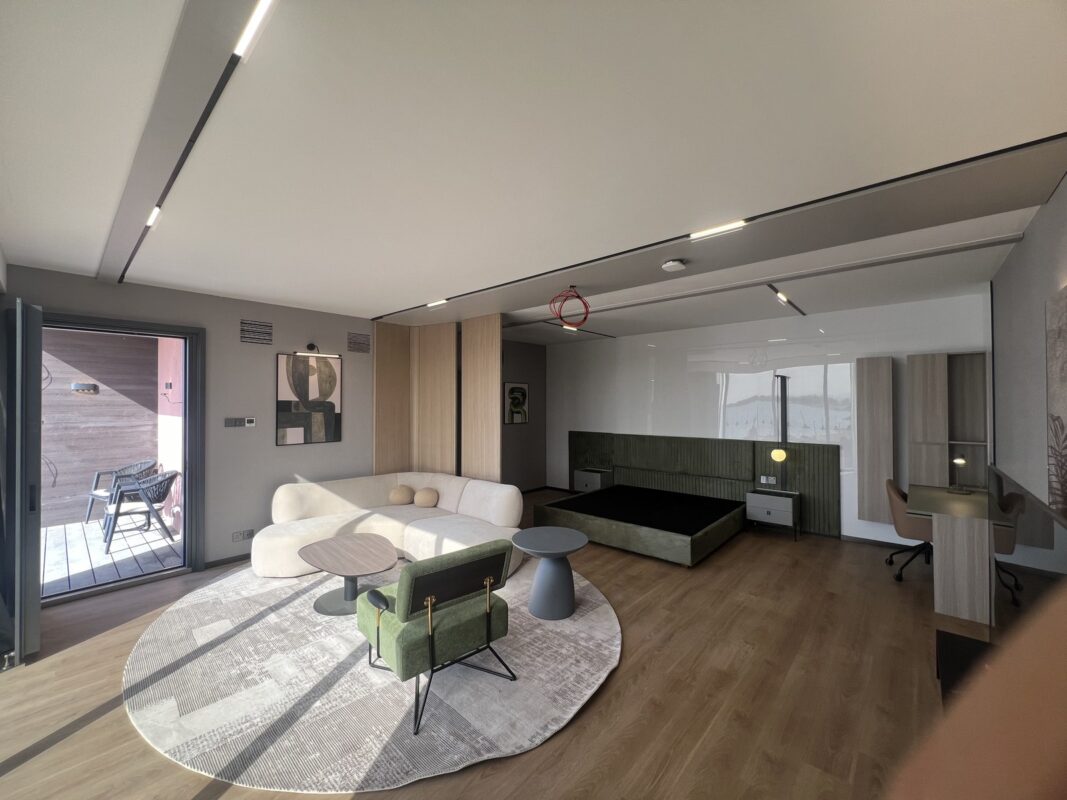
A curved sofa is priced by five inputs — overall size, frame specification, foam, fabric consumption and quantity — not by a single “curved” surcharge. Two suppliers quoting the same photo can differ substantially because one of those five is different. Ask for the five inputs in writing and the quotes become comparable; ask only for a total and the cheaper number usually wins for the wrong reason.
The five inputs
| Input | What changes | How to compare |
|---|---|---|
| 1. Size | Overall width, depth, seat height; a longer arc uses more frame, foam and fabric | Compare the same dimensions, not the same model name |
| 2. Frame | Timber species, panel thickness, segment count, joint method | Ask for species, thickness, joint and segment count — four numbers |
| 3. Foam | Density in kg/m³, one block or layered, seat firmness | Ask for density, not the phrase “high density” |
| 4. Fabric | Price per metre, weight, repeat, cutting waste on a radius | Compare fabric price and consumption separately from labour |
| 5. Quantity | Setup repeats per model; fabric is bought by the roll | Compare at the same quantity and the same mix |
Where the money actually goes
Frame segments. A curve is built from segments cut to a parameter set, with left and right sides mirrored. More segments mean more joints, more assembly time and more reinforcement. A three-segment curve costs more to build than a two-segment one, and the difference usually shows in the silhouette.
Fabric waste. Curved panels do not nest like rectangles. The offcut from a radius cannot always be used on the next piece, and pattern matching on a curve adds labour. This is why the same fabric can cost different amounts on a curved and a straight model.
Hand-pulled upholstery. The cover on a curve is pulled by hand along the radius. Loose fabric wrinkles; over-tight fabric compresses the foam and flattens the arc. It is the least standardised step in the workshop, and it is priced as skilled time.
Packing volume. A curved piece has an irregular footprint and does not nest. Fewer units fit in a container, so the freight per piece is higher even when the ex-works price is the same.
Pattern development. A new radius needs new paper patterns and new panels. That is a one-off development cost, not a per-piece cost, and it is why a “small change” to the curve can change the price more than a change of fabric.
Why a photo cannot produce a firm price
A photo shows the silhouette, not the scale. It cannot tell us the seat depth, the frame specification, the foam density or the fabric weight. We can give a budget range from a photo, but a firm price needs the dimensions, the fabric (or a fabric budget per metre), the quantity and the destination. This is also why two “same photo” quotes can be far apart: one may assume a 2.4 m three-seater in a standard fabric, the other a 3.6 m four-seater in a heavy bouclé.
What a quotation should itemise
- Model and overall dimensions, with seat height and depth.
- Frame species, panel thickness, joint method and segment count.
- Foam density and whether the seat is one block or layered.
- Fabric name, width, price per metre and estimated consumption.
- Packing method, carton dimensions, CBM and loading plan.
- Lead time counted from drawing approval and deposit.
- What is included (packing) and what is not (freight, insurance, installation, duties).
Three questions that reveal a low quote
Ask for the segment count. Ask for the foam density in kg/m³. Ask for the fabric weight in g/m². A quote that cannot answer those three is not necessarily wrong, but it has not been specified yet — and an unspecified quote is where the remake cost hides. The same logic applies to lead time: a date without a start point is not a commitment.
Questions buyers ask
Is a curved sofa always more expensive than a straight one?
Usually, because of segment labour, fabric waste and packing volume. The gap narrows when the curved model is small and the fabric is inexpensive; it widens on large radii and heavy patterns.
Can you quote a price per metre of sofa?
No, because a metre of a deep curve and a metre of a shallow curve use different amounts of frame and fabric. We quote per model and per configuration instead.
Does quantity reduce the price?
Yes, up to a point. Setup repeats per model, so a run of ten costs less per piece than a run of five. Mixing many models across many fabrics reduces that benefit.
Do you charge for drawings?
No. A three-view drawing is issued within one working day for confirmation. A new radius or a new silhouette is quoted as development, and that cost is stated separately.
Send the dimensions, a reference photo, the fabric or a fabric budget, the quantity and the destination port, and we will reply within 24 hours with a costed breakdown. Short answers on MOQ and lead time are in the FAQ; the production process is on the craft page; current models are in the curved sofa collection.
Updated November 2026. FEILIGE FURNITURE, Foshan.

