
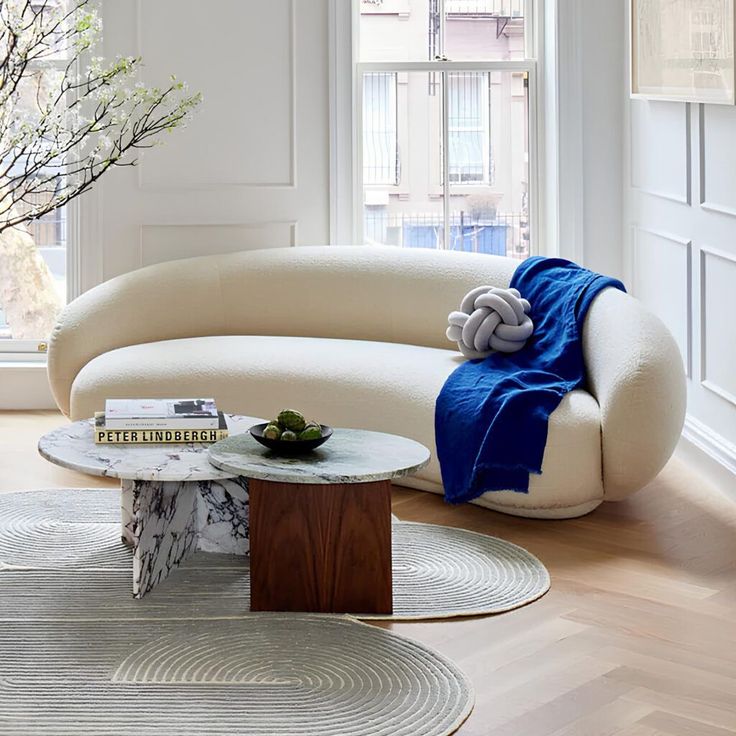
Two suppliers quote the same curved sofa. One comes back far below the other. Neither is necessarily lying. A curved sofa carries cost in places a straight sofa does not, and different workshops handle those places differently.
The curve starts at the cutting table
Frame parts for a curved model are not straight boards bent afterwards. They are cut to a set of parameters, and the left and right sides are cut as mirror images. A workshop cutting by hand can produce ten different curves from one drawing; a CNC line produces ten identical ones. The machine time and the programming behind it are part of the price.
Segment count matters too. A curve built from three segments needs more joints, more assembly time and more reinforcement than one built from two. Fewer segments is cheaper to build, and it usually shows in the silhouette.
Foam: the part you cannot see later
Foam is quoted by density and by layer. A seat built from one block of lower-density foam and a seat built from a dense base with a softer top layer look the same in a photo. They do not feel the same after a year of use, and they are not priced the same.
Ask for the density in kg/m³ rather than a description like “high density”. The number is what gets specified, ordered and inspected.
Fabric yield on a curve
A curved panel cannot be nested as tightly as a rectangular one. Pattern matching, pile direction and the radius itself all create offcuts. Two fabrics of the same width can have different usable yields on the same model, which is why the fabric choice can move the price even when the frame does not change.
Upholstery hours
Pulling fabric over a curve is handwork. Too loose and it wrinkles along the radius; too tight and the foam compresses and the curve flattens. This is the step where a cheap quote usually gives itself away — it is also the step that is hardest to standardise and easiest to rush.
Packing volume
Curved pieces do not stack as neatly as rectangular ones. A model that looks compact in a showroom can take disproportionate space in a container, and freight is charged on volume, not on how the sofa looks.
What does not change the price
Colour, model number and the name of the collection. Those are free to change. If a quote moves a lot when only the colour changes, the change is probably in the fabric itself, not the colour.
How to compare two quotes properly
- Ask for the frame specification: timber, panel thickness, joint method, segment count.
- Ask for foam density in kg/m³ for seat and back separately.
- Ask for the fabric code and its width, so yield can be checked.
- Ask how the piece is packed, and how many fit in a 40HQ for that model.
- Ask what is excluded: freight, duties, packaging, sampling.
Once those five answers sit side by side, the cheaper quote usually stops looking cheaper.
Questions buyers ask
Is a curved sofa always more expensive than a straight one?
For the same size and fabric, usually yes. The extra cost comes from cutting waste, more joints and more upholstery time.
Can the same look be produced for less?
Yes, by reducing segment count, simplifying the base or using a lower foam density. Each of those changes something you will notice later.
Does changing the fabric change the price?
It can. Width, pile and pattern repeat all affect how much usable fabric comes out of a roll.
More detail on the process sits in craft and customization. If you want a second opinion on a quote, send the drawing and we will price it line by line.
Send a drawing or a reference photo and we will reply within 24 hours.
